> ## Documentation Index
> Fetch the complete documentation index at: https://docs.ankra.ai/llms.txt
> Use this file to discover all available pages before exploring further.
# Verify a Cluster Mesh
> Prove cross-cluster traffic on a Cilium Cluster Mesh with a global service, live from the pod terminal
This guide takes a connected [Cluster Mesh](/platform/cluster-mesh) and proves it end to end: a service with backends only in one cluster, consumed from a pod in the other, verified live in the portal's pod terminal. It is the exact test we run against every mesh change — about five minutes, nothing left behind.
## What you need
* Two clusters joined to the same mesh, both members showing `ready`:
```bash theme={null}
ankra cluster mesh show
```
* `kubectl` contexts for both clusters (`ankra cluster kubeconfig add --use` on each).
Throughout this guide, **cluster A** runs the backends and **cluster B** consumes them. The direction is arbitrary — swap it or run it both ways.
## 1. Deploy backends and a global service on cluster A
The whole trick is one annotation: `service.cilium.io/global: "true"`. A Service carrying it, with the **same name and namespace** in every cluster, is one service mesh-wide — Cilium merges the healthy backends from every member.
```yaml mesh-echo-backend.yaml theme={null}
apiVersion: v1
kind: Namespace
metadata:
name: mesh-test
---
apiVersion: apps/v1
kind: Deployment
metadata:
name: mesh-echo
namespace: mesh-test
spec:
replicas: 2
selector:
matchLabels:
app: mesh-echo
template:
metadata:
labels:
app: mesh-echo
spec:
containers:
- name: echo
image: ealen/echo-server:0.9.2
ports:
- containerPort: 80
env:
- name: PORT
value: "80"
resources:
requests:
cpu: 10m
memory: 32Mi
limits:
cpu: 100m
memory: 64Mi
---
apiVersion: v1
kind: Service
metadata:
name: mesh-echo
namespace: mesh-test
annotations:
service.cilium.io/global: "true"
spec:
selector:
app: mesh-echo
ports:
- port: 80
targetPort: 80
```
```bash theme={null}
kubectl --context apply -f mesh-echo-backend.yaml
```
## 2. Create the same global service on cluster B — with no backends
Cluster B gets the Service and namespace only. Its selector matches nothing locally, which is the point: any traffic it serves must have crossed the mesh.
```yaml mesh-echo-frontend.yaml theme={null}
apiVersion: v1
kind: Namespace
metadata:
name: mesh-test
---
apiVersion: v1
kind: Service
metadata:
name: mesh-echo
namespace: mesh-test
annotations:
service.cilium.io/global: "true"
spec:
selector:
app: mesh-echo
ports:
- port: 80
targetPort: 80
```
```bash theme={null}
kubectl --context apply -f mesh-echo-frontend.yaml
kubectl --context -n mesh-test run mesh-client \
--restart=Never --image=curlimages/curl:8.10.1 --command -- sleep 14400
```
The `mesh-client` pod is your vantage point inside cluster B.
## 3. Prove it from the pod terminal
In the portal, open **cluster B → Kubernetes → Workloads → Pods**, search for `mesh-client`, open it, and switch to the **Terminal** tab. **Connect**, then run:
```bash theme={null}
hostname; for i in 1 2 3 4 5; do curl -s mesh-echo.mesh-test | grep -o '"HOSTNAME":"[^"]*"'; done
```
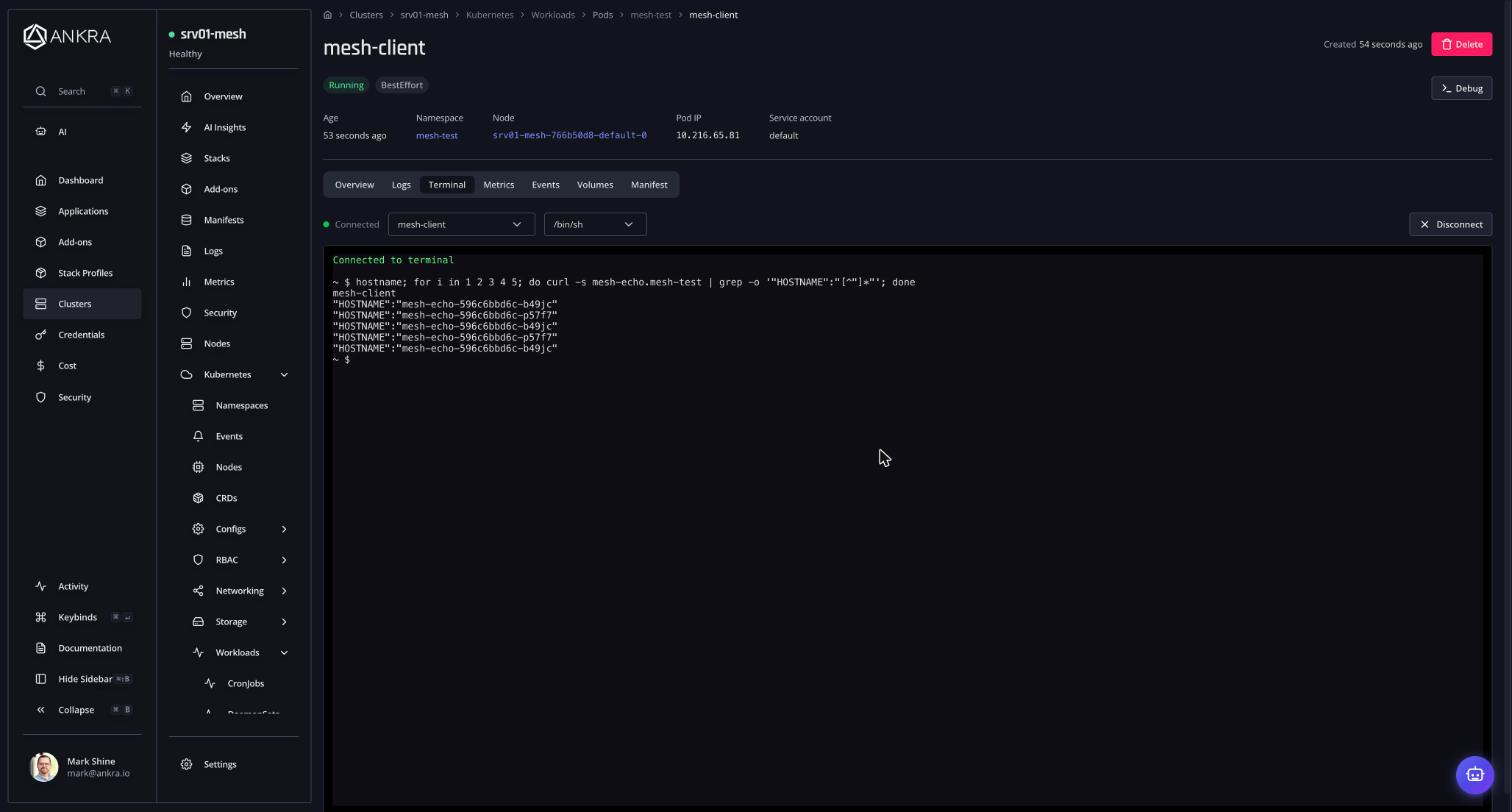 Read what the output says: `hostname` confirms you are in `mesh-client` on cluster B, and every response's `HOSTNAME` is a `mesh-echo-…` pod. Cluster B has **zero** backends for this service, so each of those responses was served across the mesh — and the alternation between pod names is Cilium load-balancing over the remote backends.
## 4. Close the loop
Open **cluster A → Kubernetes → Workloads → Pods** and search for `mesh-echo`:
Read what the output says: `hostname` confirms you are in `mesh-client` on cluster B, and every response's `HOSTNAME` is a `mesh-echo-…` pod. Cluster B has **zero** backends for this service, so each of those responses was served across the mesh — and the alternation between pod names is Cilium load-balancing over the remote backends.
## 4. Close the loop
Open **cluster A → Kubernetes → Workloads → Pods** and search for `mesh-echo`:
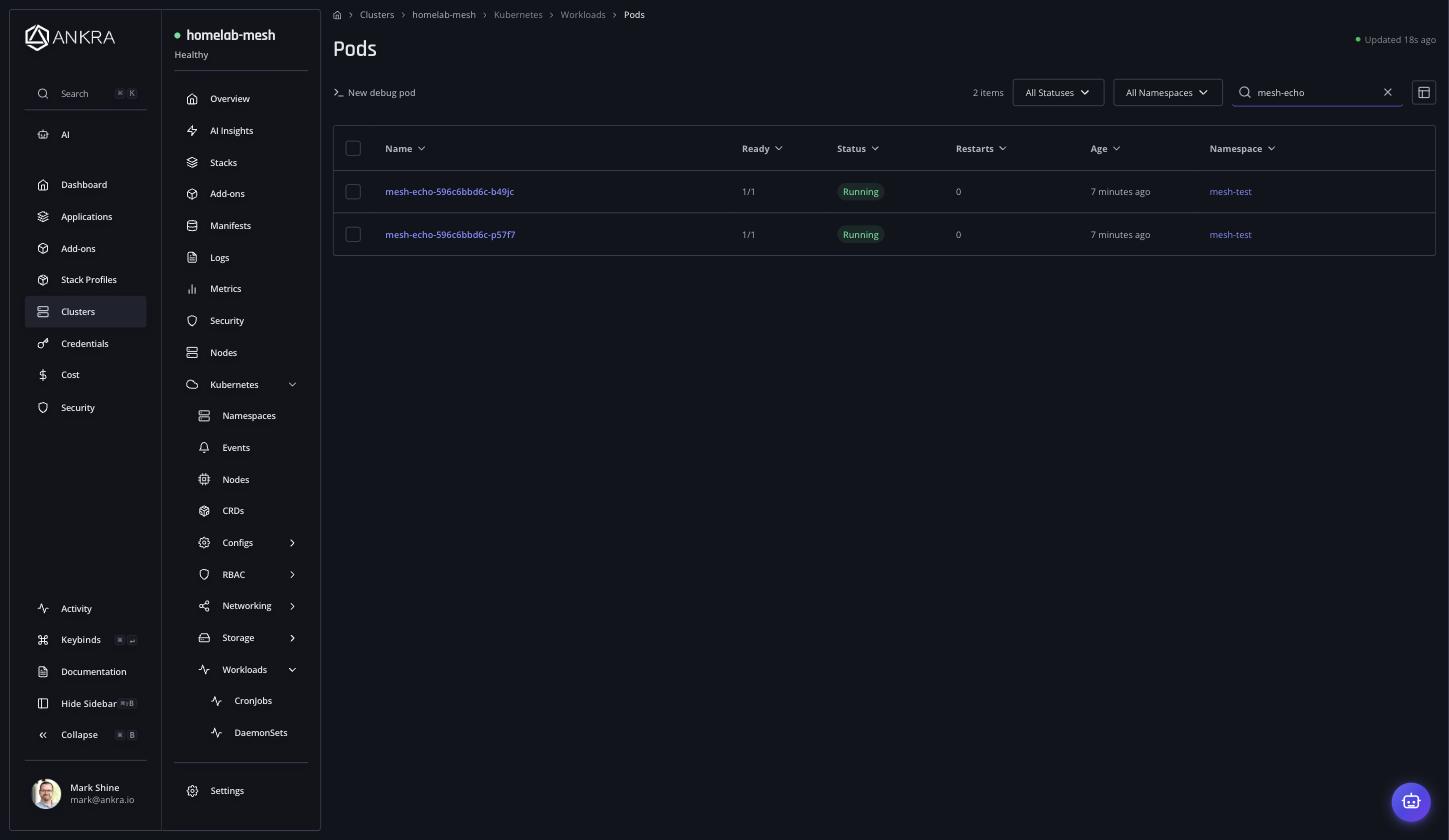 The pod names match the `HOSTNAME` values from the terminal, byte for byte. Request made on one cluster, served by the other.
## What this verifies — and what it does not
A passing run proves the whole chain at once: the shared trust root, both `clustermesh-apiserver`s, the cross-cluster service catalogue, and the pod-to-pod data path over the overlay. If you want the layer-by-layer view instead, `cilium-dbg status` inside a Cilium agent pod reports `ClusterMesh: 1/1 remote clusters ready`, and `cilium-health status` probes every node and endpoint in both clusters.
For real workloads, run backends in **both** clusters behind the global service: Cilium prefers healthy backends and a cluster losing its local ones fails over to the remote side. This guide keeps backends on one side only because asymmetry is what makes the proof unambiguous.
## Troubleshooting
* **`curl` times out** — check both members read `ready` in `ankra cluster mesh show`; a member in `configuring` has not converged yet, and `degraded` means it verified fewer peers than expected. The [Cluster Mesh page](/platform/cluster-mesh#troubleshooting) maps each status to its fix.
* **DNS resolves but only local backends answer** — the Service must carry `service.cilium.io/global: "true"` and identical name + namespace in *both* clusters; a mismatch on either side splits it back into two local services.
* **A Proxmox or on-prem pair** — confirm the site prerequisites (site address, UDP port-range forward): one reachable side is enough, but none is not.
## Clean up
```bash theme={null}
kubectl --context delete namespace mesh-test
kubectl --context delete namespace mesh-test
```
The pod names match the `HOSTNAME` values from the terminal, byte for byte. Request made on one cluster, served by the other.
## What this verifies — and what it does not
A passing run proves the whole chain at once: the shared trust root, both `clustermesh-apiserver`s, the cross-cluster service catalogue, and the pod-to-pod data path over the overlay. If you want the layer-by-layer view instead, `cilium-dbg status` inside a Cilium agent pod reports `ClusterMesh: 1/1 remote clusters ready`, and `cilium-health status` probes every node and endpoint in both clusters.
For real workloads, run backends in **both** clusters behind the global service: Cilium prefers healthy backends and a cluster losing its local ones fails over to the remote side. This guide keeps backends on one side only because asymmetry is what makes the proof unambiguous.
## Troubleshooting
* **`curl` times out** — check both members read `ready` in `ankra cluster mesh show`; a member in `configuring` has not converged yet, and `degraded` means it verified fewer peers than expected. The [Cluster Mesh page](/platform/cluster-mesh#troubleshooting) maps each status to its fix.
* **DNS resolves but only local backends answer** — the Service must carry `service.cilium.io/global: "true"` and identical name + namespace in *both* clusters; a mismatch on either side splits it back into two local services.
* **A Proxmox or on-prem pair** — confirm the site prerequisites (site address, UDP port-range forward): one reachable side is enough, but none is not.
## Clean up
```bash theme={null}
kubectl --context delete namespace mesh-test
kubectl --context delete namespace mesh-test
```