

ready, but you want proof that traffic really crosses the mesh before you rely on it. This guide takes a connected Cluster Mesh and proves it end to end: a service with backends only in one cluster, consumed from a pod in the other, verified live in the portal’s pod terminal. It takes about five minutes and leaves nothing behind.
What you need
-
Two clusters joined to the same mesh, both members showing
ready: -
kubectlcontexts for both clusters (ankra cluster kubeconfig add --useon each).
1. Deploy backends and a global service on cluster A
The whole trick is one annotation:service.cilium.io/global: "true". A Service carrying it, with the same name and namespace in every cluster, is one service mesh-wide - Cilium merges the healthy backends from every member.
mesh-echo-backend.yaml
2. Create the same global service on cluster B - with no backends
Cluster B gets the Service and namespace only. Its selector matches nothing locally, which is the point: any traffic it serves must have crossed the mesh.mesh-echo-frontend.yaml
mesh-client pod is your vantage point inside cluster B.
3. Prove it from the pod terminal
In the portal, open cluster B → Kubernetes → Workloads → Pods, search formesh-client, open it, and switch to the Terminal tab. Connect, then run:
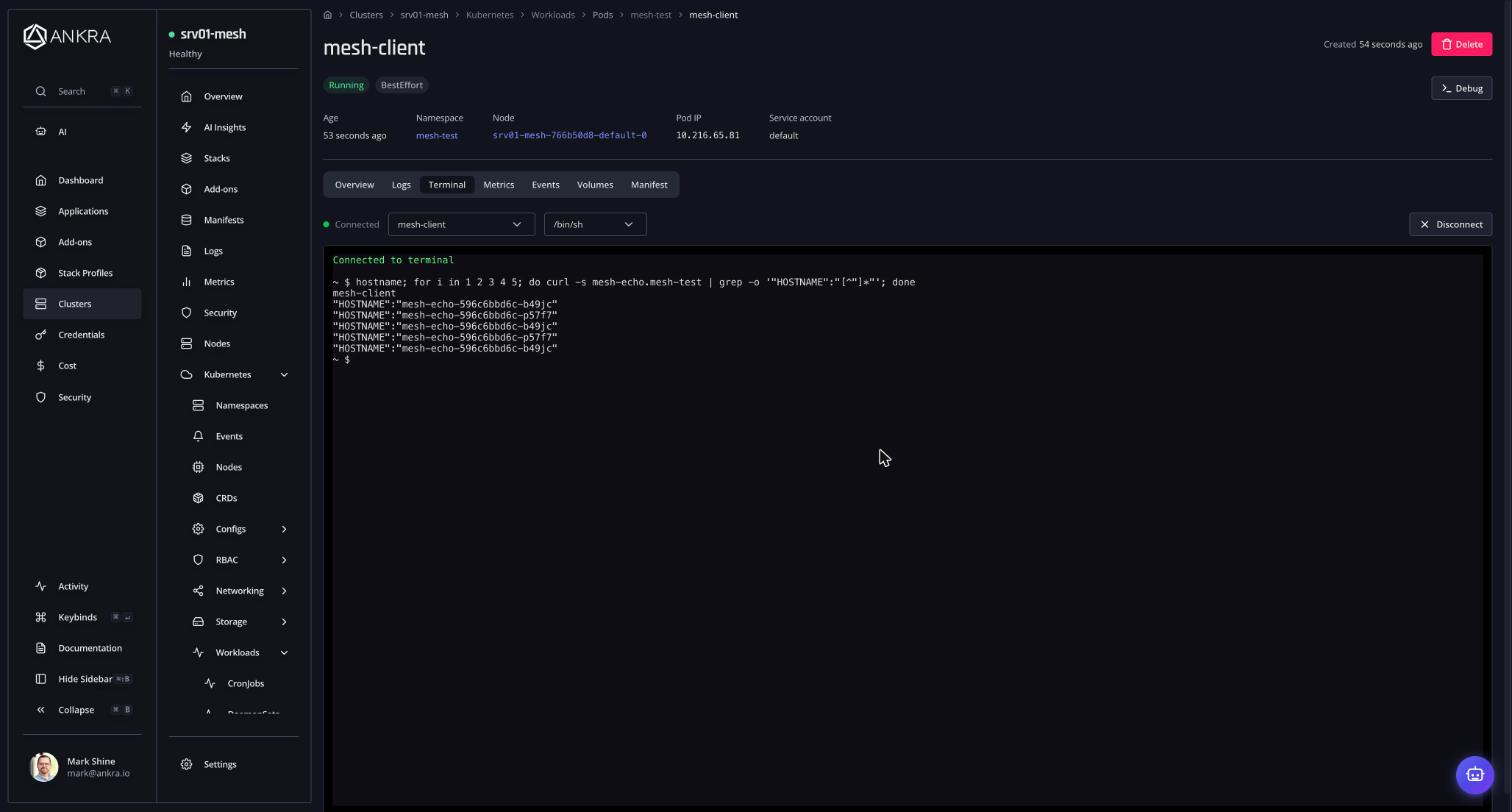
Five requests from a pod on one cluster, every response served by pods on the other - load-balanced between them.
hostname confirms you are in mesh-client on cluster B, and every response’s HOSTNAME is a mesh-echo-… pod. Cluster B has zero backends for this service, so each of those responses was served across the mesh - and the alternation between pod names is Cilium load-balancing over the remote backends.
4. Close the loop
Open cluster A → Kubernetes → Workloads → Pods and search formesh-echo:
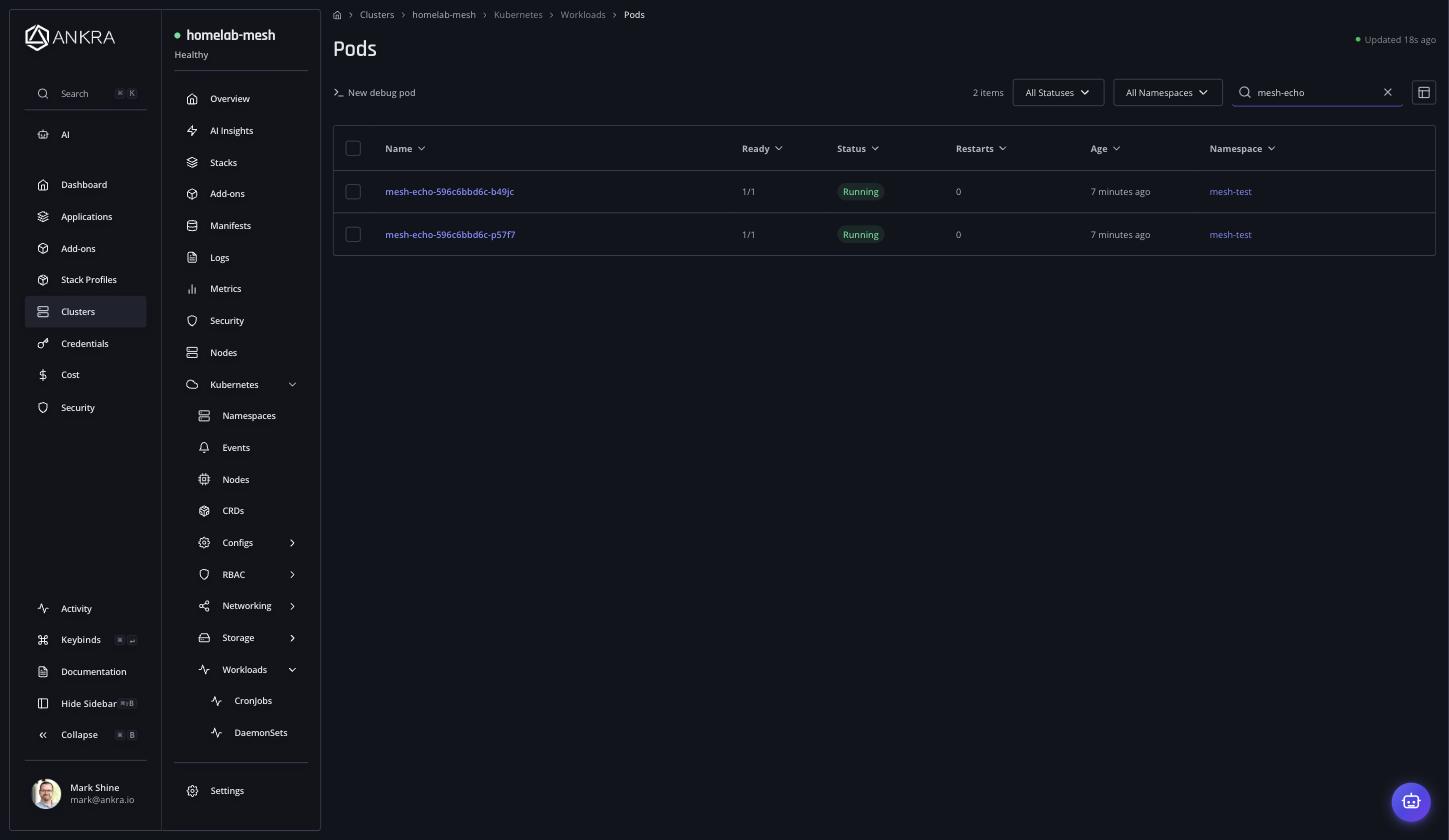
The exact pods that served the requests, running on the other cluster.
HOSTNAME values from the terminal, byte for byte. Request made on one cluster, served by the other.
What this verifies - and what it does not
A passing run proves the whole chain at once: the shared trust root, bothclustermesh-apiservers, the cross-cluster service catalogue, and the pod-to-pod data path over the overlay. If you want the layer-by-layer view instead, cilium-dbg status inside a Cilium agent pod reports ClusterMesh: 1/1 remote clusters ready, and cilium-health status probes every node and endpoint in both clusters.
For real workloads, run backends in both clusters behind the global service: Cilium prefers healthy backends and a cluster losing its local ones fails over to the remote side. This guide keeps backends on one side only because asymmetry is what makes the proof unambiguous.
Troubleshooting
curltimes out - check both members readreadyinankra cluster mesh show; a member inconfiguringhas not converged yet, anddegradedmeans it verified fewer peers than expected. The Cluster Mesh page maps each status to its fix.- DNS resolves but only local backends answer - the Service must carry
service.cilium.io/global: "true"and identical name + namespace in both clusters; a mismatch on either side splits it back into two local services. - A Proxmox or on-prem pair - confirm the site prerequisites (site address, UDP port-range forward): one reachable side is enough, but none is not.